Liter[r]a [eng]
In Latin, the word litera refers to both a graphic symbol and the entire body of literary works. Literature is an important and special form of culture – both dialogic and self-reflective. This unique quality manifests on an individual, social, intercultural and geopolitical levels. Hence the significance of efforts to ensure mutual cross-fertilisation of literatures from different linguistic areas and intensive circulation of literary works on a global scale. Liter[r]a is our expression of care and efforts to promote Polish literary works abroad and support people who are able to take on literary translation challenges: linguistic, cultural, artistic, social and political.
In a world where communication increasingly assumes the form of slogans and memes, literature provides us with a unique opportunity to understand ourselves and each other to the fullest, also across borders. The Liter[r]a series of translation workshops and author meetings consists of ten events devoted to contemporary Polish literature, organised in five most important cultural and academic centres in Europe: Paris, Sofia, Lviv, Oslo and Granada.
The dialogic dimension of literature is reflected in the very formula of Liter[r]a events, where we host the co-creators of the intercultural literary dialogue, i.e. authors and translators of their works. During specialist translation workshops, their dialogue will be shared with university students of the Polish language and culture, translation trainees and people keen to explore such professional opportunity. The evening meetings with authors, which are open to a wider audience of experts curators, academics, media and, above all, the community of readers, provide space for an in-depth discussion of the vital role of literary translation as a form of co-creation of contemporary literary texts, as well as the reception and the dialogic potential of Polish literature in individual countries and language areas.
The Liter[r]a series is an initiative of the Olga Tokarczuk Foundation, implemented in cooperation with foreign partners, with the financial support of the Polish Ministry of Culture and National Heritage within the Promotion of Polish Culture Abroad programme for 2026.
On May 15, 2026 in Sofia we will meet in the Faculty of Slavic Studies at Sofia University “St. Kliment Ohridski” for a literary translation masterclass led jointly by Julia Fiedorczuk, the author, and Krum Krumov, the translator Dom Oriona (Домът на Орион, ICU 2026).
The House of Orion invites on a journey through time, across places, through green borders and into the depths of a restless mind. Julia Fiedorczuk traces the source of meanings, recovering kinship ties between a dying star and a mineral whose chance discovery will have proved so impactful for humankind. The writer highlights the inextricable links between things and phenomena, the impact of each movement, however slight, on the rapidly and ever-changing world. It is no coincidence that the main character, Eliza, finds temporary refuge in the Białowieża Forest – an ancient woodland, one of Europe’s most biologically diverse areas, home to many creatures, and the backdrop to an escalating migration and humanitarian crisis. As ambiguity seeps into the fundamental concepts, it is only through movement that Eliza manages to draw closer to Lou – her mythical friend and unrequited love, the truest, most vivid part of herself.
An evening meet-the-author event with the writer and translator at the Umberto&Co bookshop in Sofia will be hosted by Nevena Dishlieva.
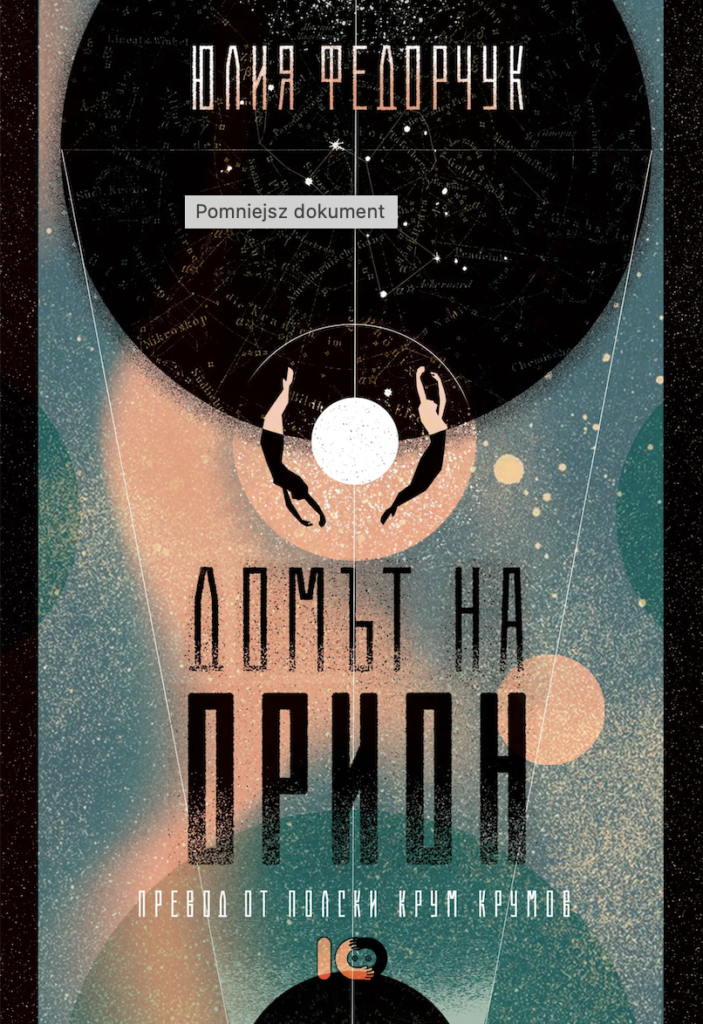
Literary translation masterclass:
Julia Fiedorczuk and Krum Krumov (Dom Oriona /Домът на Орион, ICU 2026)
Registration at: sekretariat@fundacjaolgitokarczuk.org
Date: May 15, 2026.
Authors’ meeting:
Meeting with Julia Fiedorczuk and Krumem Krumovem (Dom Oriona /Домът на Орион, ICU, 2026) hosted byNevena Krysteva. The meeting will be translated into Bulgarian/Polish.
May 15 2026 at 18:45
Vanue: UMBERTO&CO. София център, ул. „Славянска“ 14, 1000 София
https://www.umbertoandco.com/
Partnerzy
This project is co-financed by the Minister of Culture and National Heritage
of the Republic of Poland from the Culture Promotion Fund